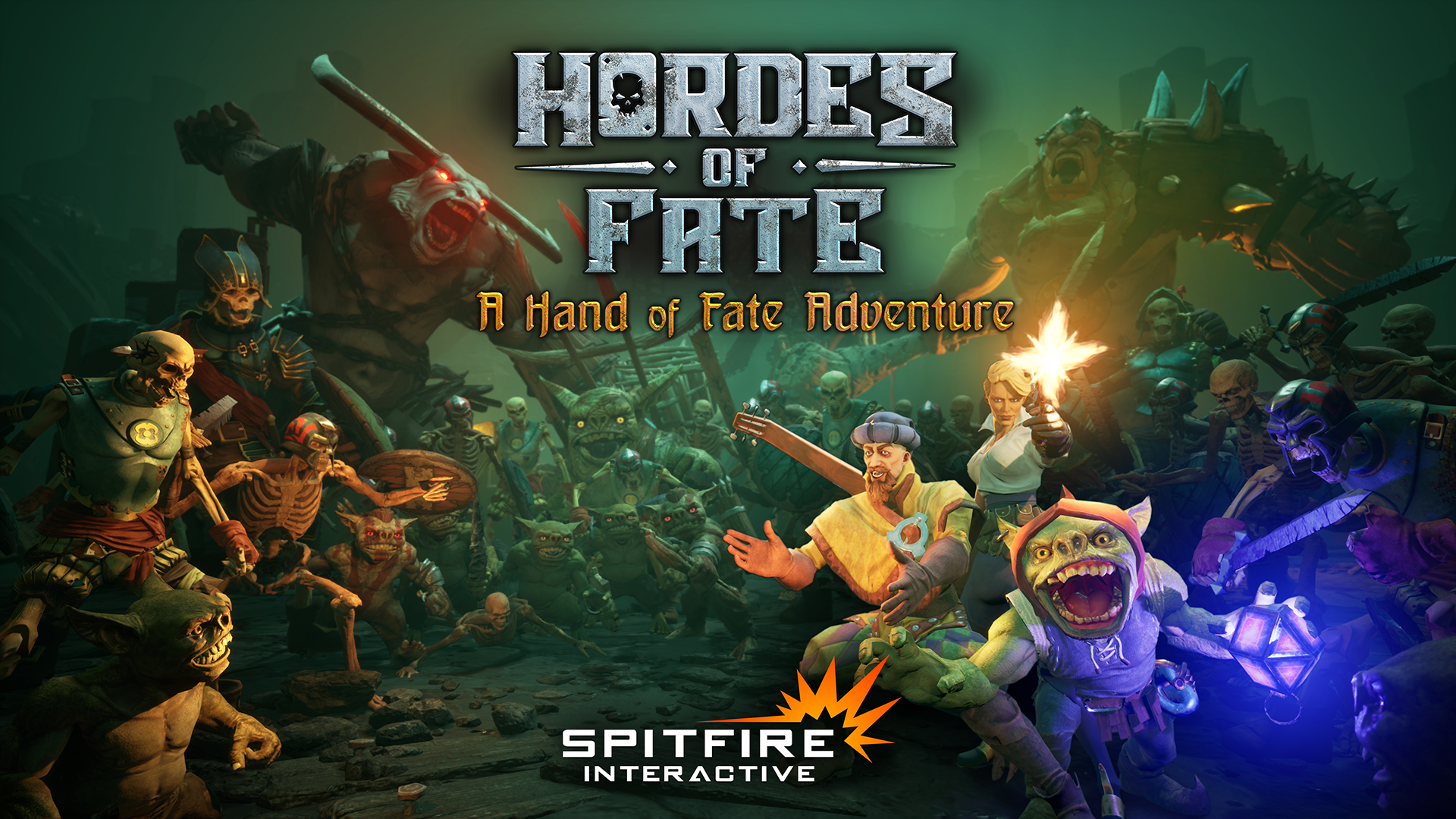
If you ever played Hand of Fate then your probably already heard the news , but incase you haven’t a spin-off is coming ! Hordes of Fate : A Hand of Fate Adventure is coming as a Deckbuilding meets auto-shooter in this new title from the original creative team. We got to interview Cade Franklin the Creative Director on this new game to tell us all about some of what’s to come, in a Rapid interview of 20 Questions .


1) First off, Can you introduce yourselves and tell us a bit about your role on the team?
Hi my name is Cade Franklin, I’m the Creative Director at Spitfire Interactive. I am chiefly responsible for the game’s design and work closely with the team to create a clear and consistent game vision.
2) How did the idea for Hordes of Fate first come about? Was it a concept that had been simmering for a while?
Hordes of Fate was first suggested by Dan Treble, one of our programmers, who had been playing a lot of Vampire Survivors and other similar games. He was keen to try prototyping something in this space and see if we could bring a Hand of Fate flavour to it.
3) What was it like reuniting key members of the Hand of Fate team under the Spitfire banner?
We all have such fond memories of working on the Hand of Fate games, we all poured so much of ourselves into them and I think everyone involved in those games learned so much and grew so much from the experience.
When the opportunity came to work together with some of the old crew, I think it was a no-brainer – we knew we had to give it a chance.
4) What drew you back into the Hand of Fate universe after all these years? Was there unfinished business, or just a creative itch you had to scratch?
I always loved how Hand of Fate was an interesting mix of ideas. The mix of board games, text adventures, the ‘cards to life’ and the 3D action combat and of course the Dealer encouraging you to take risks only to laugh at your misfortunes, it just never grows old.
For me personally, I never expected to be returning to this world, but again when the opportunity presented itself it was very, very hard to say no!
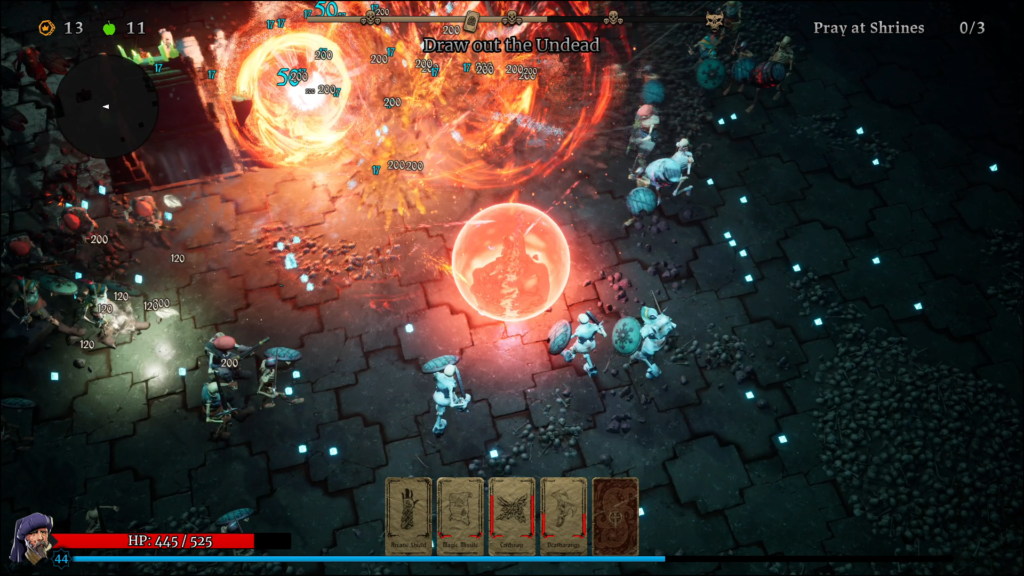
5) Hordes of Fate introduces a new auto-shooter spin on the Hand of Fate formula. What inspired the transition from a deckbuilding action RPG to a survivor-like bullet heaven experience?
A big factor was just being pragmatic – Spitfire Interactive is effectively 4 devs which is significantly less than what made the Hand of Fate games. By effectively simplifying combat requirements and doubling down on the aspects that make Hand of Fate so iconic, we figured we’d be able to deliver a really high quality and polished game that people would really enjoy.
6) Deckbuilding remains at the core of the game, but now it’s tied to progression in a fast-paced auto-shooter. How did you go about balancing the strategic depth of deckbuilding with the immediacy of bullet hell combat?
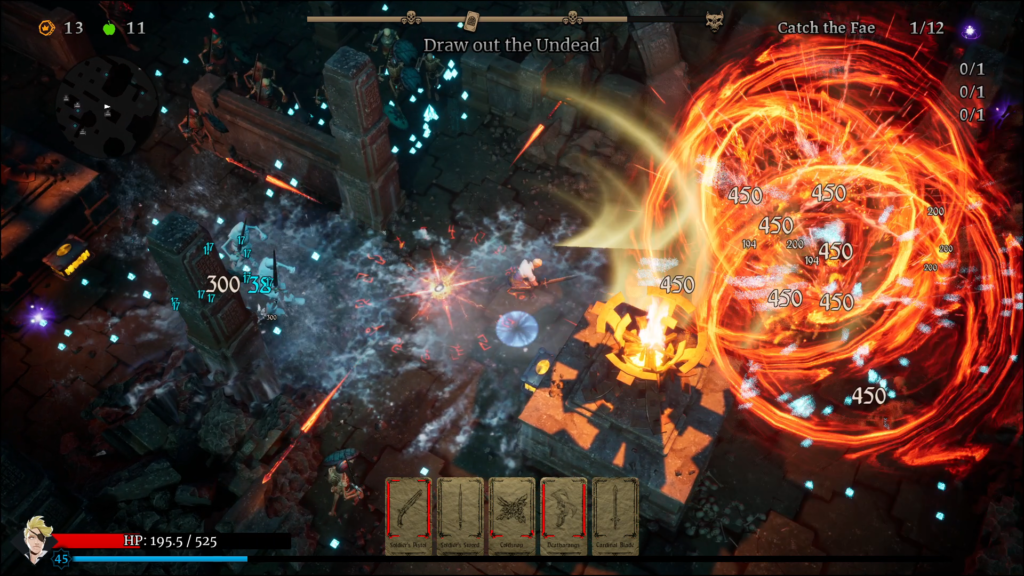
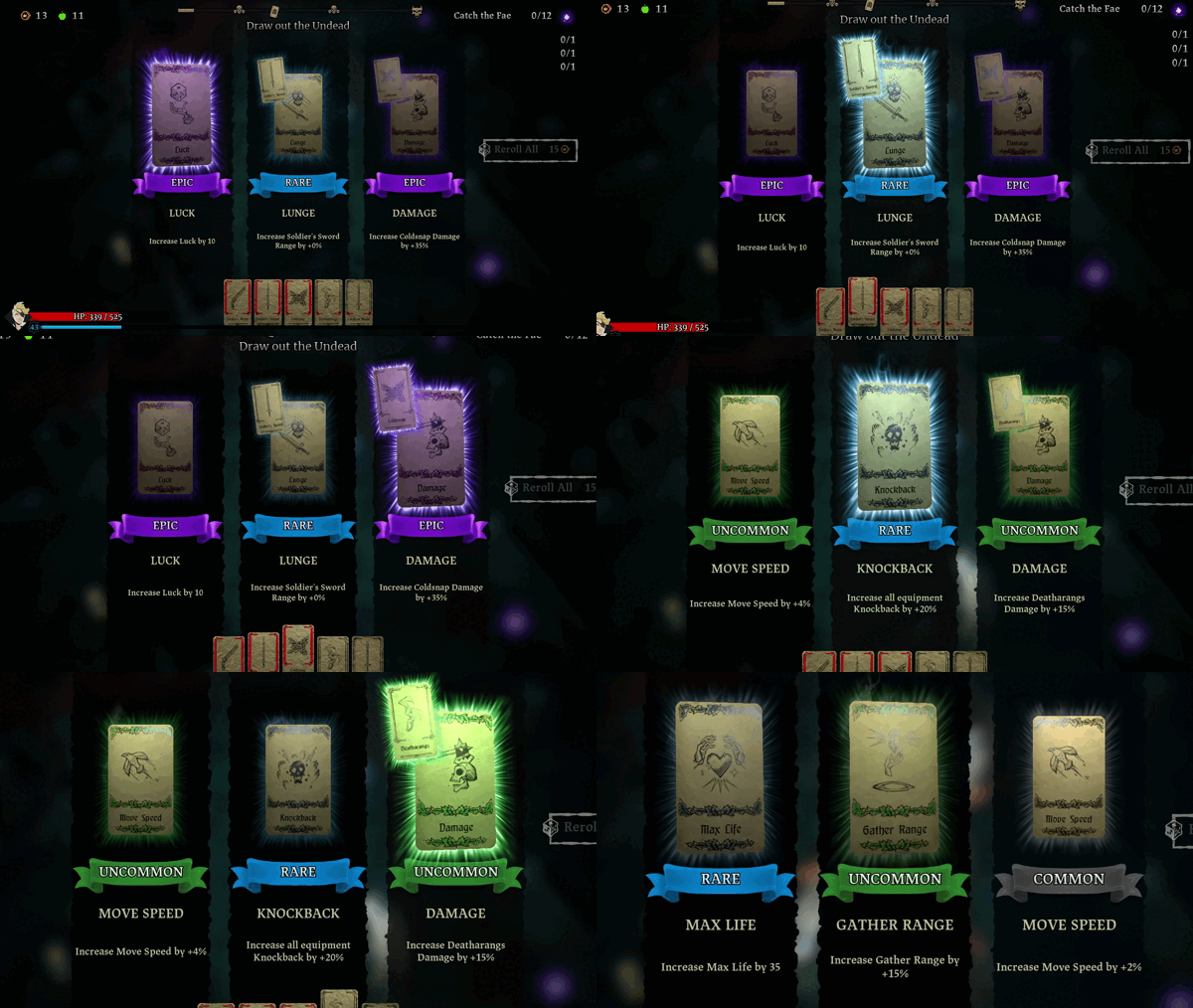
We really wanted to push what was possible with synergies between heroes and equipment and how each run would be offering you new choices, or combinations of choices, in a way that Hand of Fate’s pre-run deckbuilding sometimes doesn’t allow. The addition of card rarities helped make the decisions more interesting on this front; you might start a run planning to get area of effect weapons and upgrades, but be presented with some high rarity projectile count upgrades early on which are just too good to pass up and all of a sudden you’re picking totally different equipment and complimentary upgrades to adapt to the new strategy.
I think that this really pushes the player to explore and try out more of the cards that are available rather than always relying on old favourites; although that is still a valid tactic from time to time.
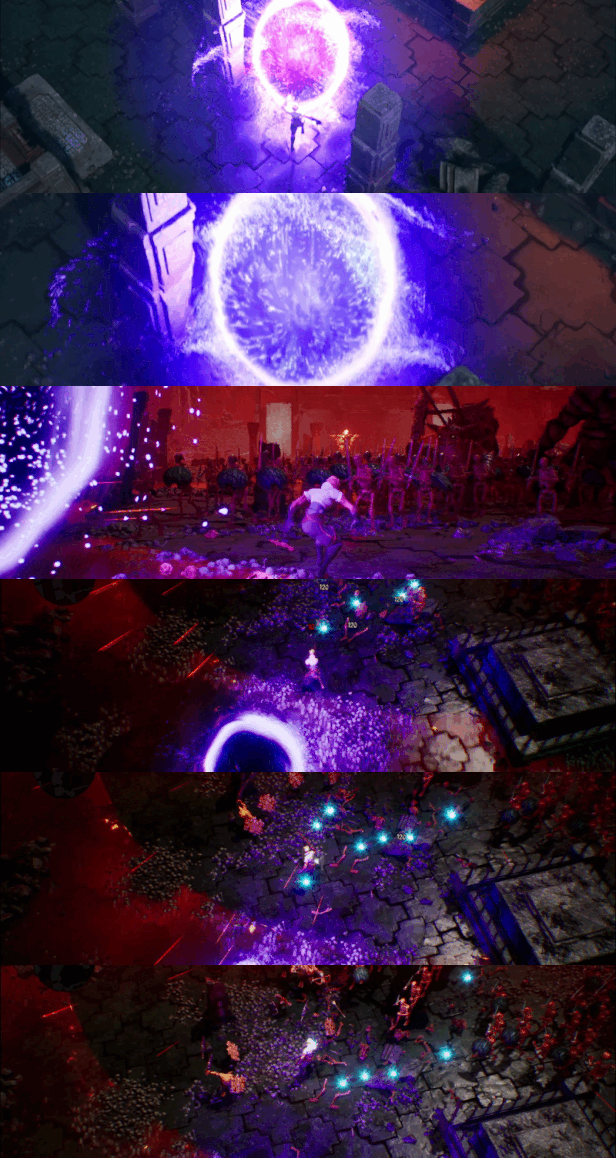
7) One of the most compelling features of the original Hand of Fate games was how they blended narrative and mechanics so seamlessly. How are storytelling and narrative design being handled in Hordes of Fate, especially with the shift to a much faster gameplay format?
This was really the biggest opportunity to deliver something different in this space. We knew we had to have Hand of Fate style text adventure moments during combat, but we were unsure if this would hold up in practice – how long can you take the player out of the fight and not forget what’s going on after an encounter ends?
We’ve definitely attempted to air on the side of brevity for the encounters, and lean into how your hero, equipment and even upgrade choices factor into the available encounter options and outcomes.
Hand of Fate’s narrative has always played with the concept of memories, and I was keen to explore how we could tell stories about the weapons that exist in this world and how they came to have the powers that they do.
The Dealer also has an overarching story to tell and that will be woven throughout, which is always a fun element to Hand of Fate.
8) How do the new heroes in Hordes of Fate reflect or expand upon characters from the earlier games? Are there returning faces, and how do their unique weapons and perks influence strategy?
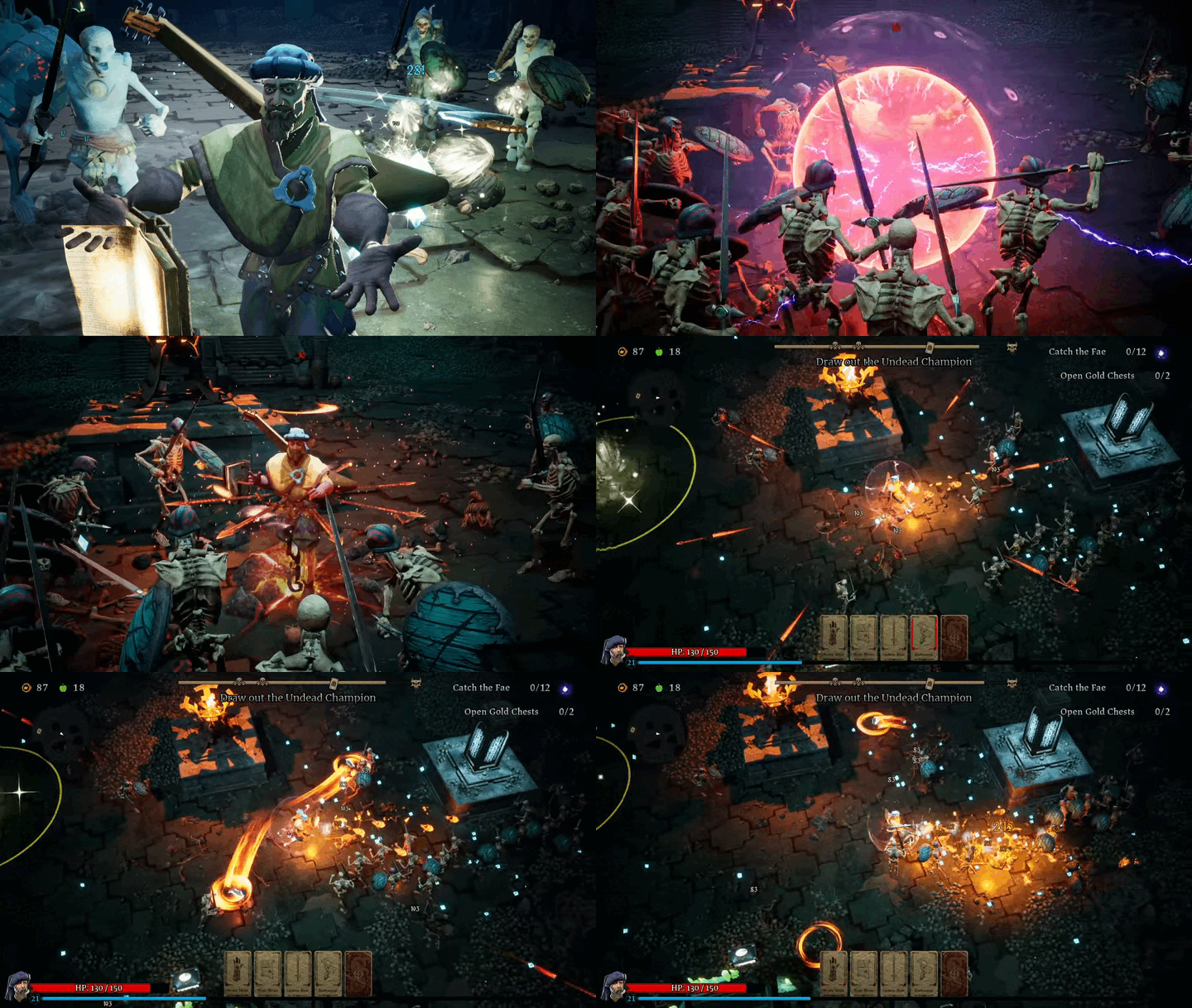
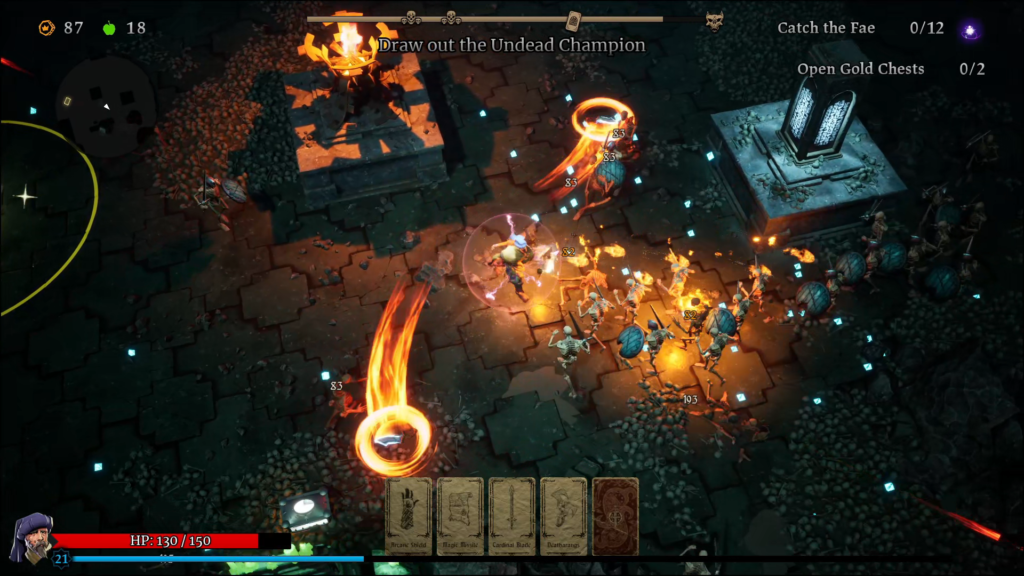
We aren’t ready to share who the full cast of characters in the game will be, but that said there will absolutely be returning faces. The demo features one of the player’s companions from Hand of Fate 2, Malayclypse the Trickster, playable for the first time in Hordes of Fate. Each hero has their own loadout of equipment, an auto-attacking weapon and a manually activatable piece of equipment. In Malaclypse’s case his spell book sends out a barrage of spells at the nearest target while his Gloves of Shielding can be cast at the players choosing to protect themselves from damage.
The Trickster is one of our starting heroes and as such requires a relatively low skill threshold to use, while some of the other unlockable heroes, particularly the melee characters, require more skill and more attention to what’s going on while playing. Each hero also has a series of branching upgrade paths that further change up each run’s possibilities, and this couples with the pool of equipment that offer even more varied synergies, and ultimately different ways for each run to play.
9) From a design standpoint, what was the most challenging aspect of translating the Hand of Fate universe into a top-down auto-shooter?
The biggest challenge has been ensuring that the Encounters that are in each stage provide compelling value and are worth the player’s time to interact with and discover their secrets, versus just fighting enemies and gathering XP to progress through a run.
The turning point for this was moving our Enchantment upgrades, which are extremely powerful, to the encounter rewards, and in many cases pushing these to encounter options that required the player to engage with the elements of the game that we feel are unique and the most Hand of Fate-y, like having certain items or enough gold or food for the task.
It’s the use of game mechanics to reinforce what makes Hordes of Fate unique that has proved to be the most challenging, but ultimately the most rewarding challenge so far, while still staying true to the new genre we’re adopting.

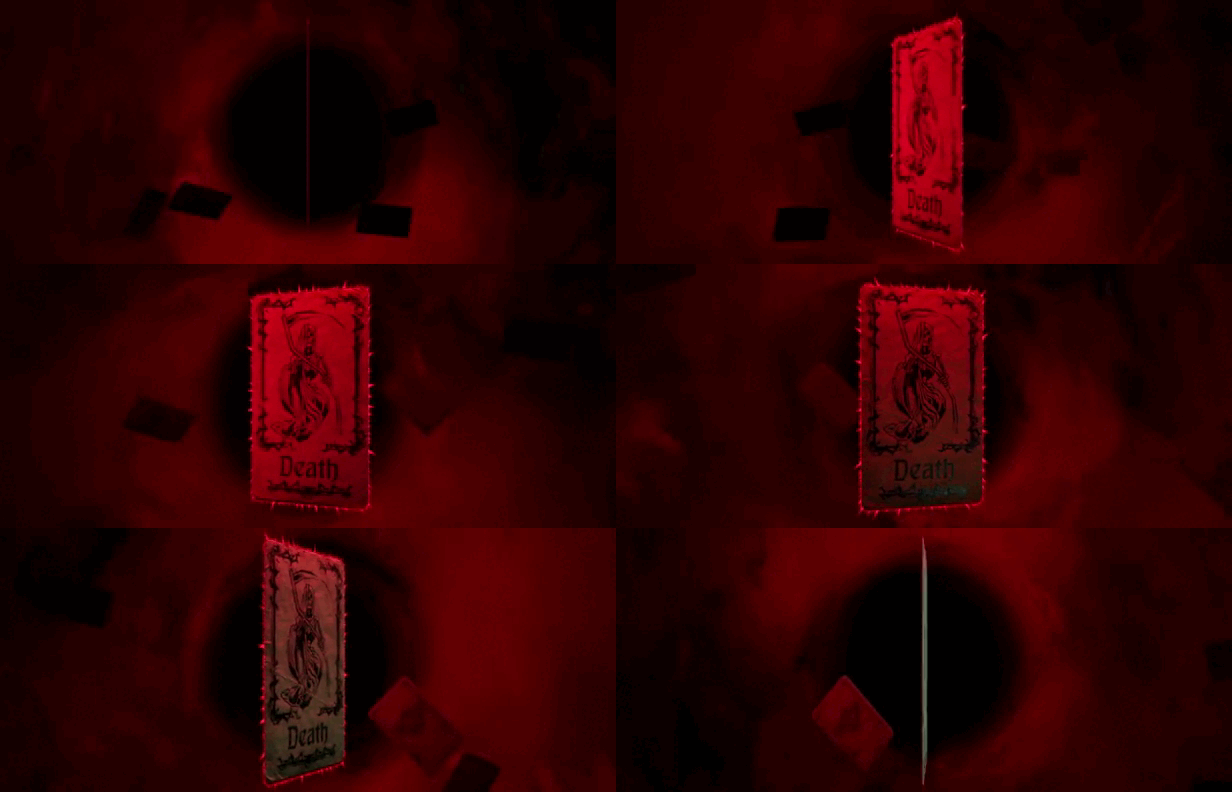
10) The Dealer has always been a defining voice of the Hand of Fate series. Can fans expect his return, and if so, how is his role evolving in this new take?
The Dealer will absolutely be returning for Hordes of Fate. Beyond this, we’re not quite ready to share everything about his motives and how he feels about the player this time around.
11) Players will be familiar with the concept of “Tokens” unlocking new cards and content. Has that progression system changed in Hordes of Fate, and if so, what new twists can we expect?
Tokens also make a return. I think the biggest twist here is more about the types of cards that they unlock and why. In Hordes of Fate, the story is just as much about the player’s equipment as it is the characters themselves. As such completing certain encounters with certain weapons will unlock additional Enchantments to the upgrade deck. These enchantments can be extremely powerful and can really change up the properties of a weapon.
A simple example might be taking the Hand of Fate 2 inspired artefact Coldsnap (a frost bomb) to the Heart of the North encounter and choosing the options to absorb the harsh blizzard conjured by a Northerner Shaman, and unlock a massive Frost Potency enchantment. This enchantment can then be gained on subsequent runs, regardless of if the encounter is attempted or not.
12) The weapon enchantment system sounds like it allows for a huge amount of build variety. Can you give us an example of how a single weapon can branch out into completely different styles of play?
Yes, I mentioned the Trickster’s Gloves of Shielding already. They are an activatable bubble shield that can absorb a hit during combat. This is simple enough and allows the player to escape danger in a pinch. However, gaining the Arcane Aura enchantment allows the gloves to deal continuous pulse of damage to an area around the player while it’s active, allowing the player to skillfully weave through their opponents and deal additional damage. On the other hand, gaining the Arcane Resolve enchantment doubles down on protection offering a second hit in combat. While this may not seem too advantageous at first, it pairs with other enchantments and upgrades that triggers when the bubble is hit, effectively gaining a second chance to do so per use and greatly increasing its effectiveness. These two choices alone can drastically change up the way you engage with the enemies and play the game, and similar branches exist for other equipment in the game also.
13) Capes was a notable departure from the fantasy roguelike formula. What lessons from that game—narrative, gameplay, or team dynamics—carried over into Hordes of Fate?
Storytelling has always been an important part of the games we make. With Capes, we took on a relatively linear narrative structure, to tell that story. We’re very proud of Capes, but with a structure like that it does limit how flexible things can be narratively; you don’t have a completed game until all the story bits are complete, and adding additional story beats along the way can be a real challenge late in development, even when those ideas are really cool. Overall I think Capes succeeded with its story, however with Hordes we really wanted the flexibility that was afforded to us with the non-linear narrative that is synonymous with Hand of Fate.
Mechanically, we learned a lot with our Capes’ team-up system which really set a solid foundation for how we’d tackle synergies between equipment, enchantments, blessings and upgrades in Hordes of Fate.
One thing I’ll note is that we were always conscious of creating a balanced game with Capes; each damage point, skill, etc was considered against all the rest to limit dominant (and potentially boring) strategies. Hordes comes with a lot more freedom to create insanely powerful builds by making good choices and building synergies, but because of the roguelike structure, each run is reset and a different variety of options are presented on subsequent runs. This was absolutely something we were excited to explore with the new game.
14) How closely did Spitfire Interactive collaborate with Defiant on this project, and what was the handoff process like between the original devs and the new team?
Spitfire Interactive is comprised of the key creative team behind Hand of Fate and so we already come with a lot of knowledge about the world, including the things that didn’t quite make it into past games. I can only speak for myself and Spitfire, but I think that Defiant are really happy to see Hand of Fate get a new lease of life, and have been really generous with letting us take it on again.
15) Im going to combine two questions here : The announcement of Hordes of Fate surprised fans, especially considering that Defiant ceased game development in 2019. What changed between then and now that made returning to the Hand of Fate universe viable?
16) To put it more directly—back in 2019, Defiant cited a “risky business model” as the reason for stepping away from game development. And yet, here we are with a new Hand of Fate game in 2025. What made this return not just possible, but necessary?
Defiant was a team of 30, Spitfire is a team of 5, which speaks to the substantial difference in the business model between then and now. Fundamentally, Hand of Fate is a world we understand better than anyone else, and it gives us a great jumping off point to try and build something that combines the familiar with the fresh. Long term, our goal is to add to that legacy.
17) Crunch and work-life balance were major values at Defiant. How has that culture been preserved or evolved at Spitfire, especially now that the team is revisiting such a beloved and high-stakes IP?
There’s always a lot of pressure to deliver great games, I think that’s true of working on an existing IP like Hand of Fate, or starting something completely new.
For us, we all work from home now, which offers us a lot of flexibility with respect to working hours, which is something that we all really value. We’re all parents so being able to spend time with them as needed is really important.
18) Hordes of Fate is described as keeping each run unique through card choices and enchantments. How do you design for long-term replayability without overwhelming the player with too many options too early?
There’s always a balance to be made with how new systems and mechanics are introduced to the player, and as you suggest, how you then keep each run fresh and unique. This is something we’re still bringing together, but effectively, it’s about how we build out the player’s deck of enchantments and encounters that introduce things at a consistent pace that feels rewarding, but not overwhelming.
Another axis that we’ve tackled this, which is a first in a Hand of Fate game, is card rarity. By starting with common encounter cards early in the game, we build a solid base for what to expect from each of these unique encounters, but as the game progresses and the encounter rarities rise new varied options and outcomes become available. Some of these encounters may be played a bunch, but by including extra depth as the player progresses in the game, more possibilities are introduced to the player. Our goal here is to keep things fresh with new surprises (or less frequently explored options) while attempting to not overwhelm the player with too much too soon.
19) Community engagement played a huge role in the success of the first Hand of Fate, especially through Kickstarter. Are there plans to bring the community into Hordes of Fate’s development or post-launch roadmap in a similar way?
This is something we’re really excited about, although exactly how this will work is still being discussed. That said, this is one of the key reasons we’re keen to get the Demo out, to give players a glimpse at what the game is about and what it’s like and for us to then see what players have to say, what they’re liking and wanting to see more of, what their expectations are and of course addressing things that might not be as popular.
We’ve got a pretty active private playtesting Discord group and we’re really keen to expand that conversation to our public Discord once the demo is live.
20) Finally, how do you want returning Hand of Fate fans to feel when they boot up Hordes of Fate for the first time? And what would you say to new players entering this world with no prior knowledge of the series?
Hordes of Fate drops you once more into a world of memory, mythology, and mayhem. The autoshooter gameplay combines with the ability to stack your deck, choose your encounters, and control your destiny. A lot of this should feel familiar to a Hand of Fate fan, but also there’s a lot that’s new and fresh.
For new players, I’m excited for them to experience a Hand of Fate game and see how it pushes the boundaries of the survivorlike genre. Especially those who may be weary of the genre, I would encourage them to check out Hordes as I think we’re doing things a little differently.
It’s really exciting to think Hordes will be introducing a whole slough of new players to the world of Hand of Fate.