Summary
If the developers tighten the dice descriptions and polish the shop readability, this could stand among the best dice-builders out there. As it stands, it’s still one of the most engaging examples of how luck and skill can dance together in perfect rhythm.
Developer – goodviewgames
Publisher – Yogscast Games
Platforms – PC (Reviewed)
Review copy given by Publisher
Dicealot takes one of gaming’s oldest temptations, the roll of a die, and turns it into a full-blown roguelike obsession. Every roll has weight, every result teeters between triumph and disaster, and the tension builds until you start to second-guess whether you should roll one more time or hold your breath and bank what you’ve got. It’s a design built entirely around risk and reward, and when the gamble pays off, it feels absolutely electric.
Set in the chaotic yet oddly charming world of Camelot, Dicealot mixes medieval fantasy with the thrill of Farkle-style push-your-luck mechanics. You’re not just rolling dice to attack; you’re crafting strategies around them, manipulating odds, and building synergies between dozens of dice types. At its best, the game feels like a brainy casino of chaos where math, luck, and momentum all collide.
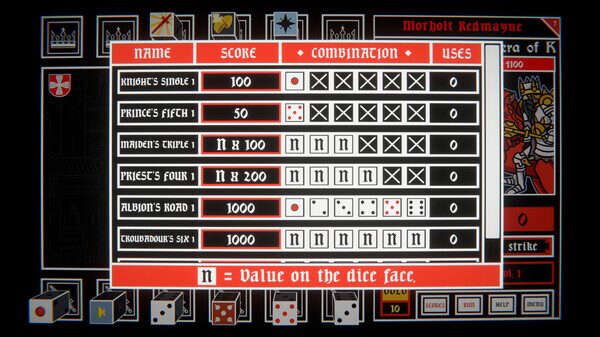
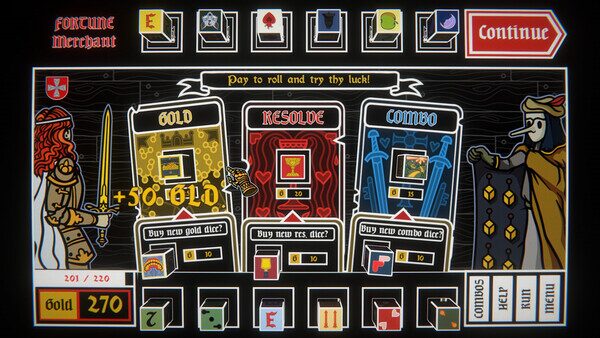
Every run starts small, with basic dice and humble numbers. But the real depth kicks in once you reach the shops between battles, where you can expand your dice collection. The idea is brilliant: turn a simple hand into a custom-built machine of probability and pain. Yet, the shop system is also where one of Dicealot’s few frustrations creeps in. Many dice lack clear or detailed descriptions, making it hard to know what they’re best suited for. In a game where precision matters, that lack of clarity can lead to wasted gold or suboptimal builds that feel unfairly punishing rather than strategically challenging.
Still, once you get the hang of how certain dice interact, the experimentation becomes addictive. You’ll start to recognize the difference between a die that boosts your score, one that manipulates enemy rolls, and one that’s a pure wild card begging to backfire at the worst possible moment. It gives every run its own rhythm, and the more you play, the more you begin to trust your instincts instead of the numbers.
The combat itself borrows inspiration from Farkle but spins it into something that feels completely fresh. Each turn, you’re faced with the eternal question: do you push for another roll to build a higher combo, or cash out before the universe laughs at your greed? That psychological tug-of-war is the heart of Dicealot. Losing it all because of a single bad roll can sting, but pulling off a massive chain that wipes out an enemy feels like defying fate itself.
The game’s medieval theming gives the chaos a whimsical backbone. You’re rolling dice to save King Arthur, battling irate maidens and monstrous oddities in a world where logic is optional and luck reigns supreme. The writing doesn’t take itself too seriously, which works in its favor. There’s humor in the absurdity of gambling the fate of Camelot on a single die, and the tone stays light even when the odds are stacked against you.
Dicealot’s ten weapon types add another layer of replayability, each one drastically changing how you approach risk. Some weapons favor consistent, smaller strikes that let you play it safe, while others demand that you live on the edge, stacking massive combos for explosive payoffs. It’s an elegant system that ensures no two runs feel quite the same.

The variety of enemies keeps you guessing, too. Each opponent brings unique dice and abilities to the table, forcing you to adapt mid-run rather than coast on a single strategy. Some fights are almost puzzle-like, requiring you to figure out what combination of rolls can break through an enemy’s defenses or exploit a particular weakness.
Dicealot rewards both planning and impulsiveness, which is a tough balance to strike. There’s an undeniable satisfaction in knowing that every mistake is your own doing, yet there’s also enough randomness to keep even perfect play unpredictable. That constant tension between control and chaos is what keeps you rolling “just one more time.”
The art direction leans into its medieval madness with bold, colorful designs that make even a menu screen feel lively. Each die has personality, each foe oozes character, and the whole experience radiates a playful sense of danger. The soundtrack complements it nicely with jaunty battle tunes that keep your heart rate high as you weigh your next gamble.
Difficulty scales well across the seven available levels, making it approachable for newcomers but punishing for those chasing mastery. Higher difficulties don’t just inflate numbers; they introduce enemies and dice that demand smarter risk management, forcing you to unlearn bad habits and rethink your luck.
Despite the polish, there are moments where Dicealot’s systems feel a bit opaque. The dice descriptions in the shop really need more clarity. For a game so dependent on knowledge and risk evaluation, guessing what a new die actually does can feel out of place. It doesn’t ruin the experience, but it can lead to moments of frustration that break the game’s otherwise elegant rhythm.
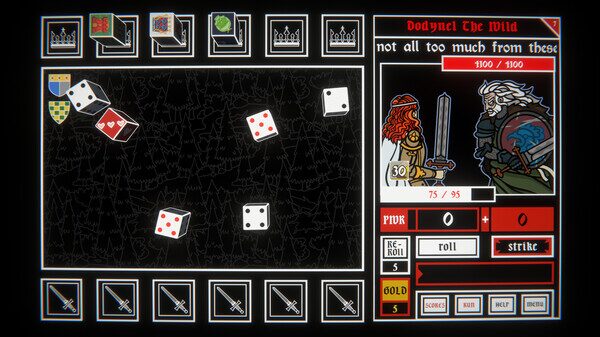
Outside of that, the structure is tight and rewarding. Runs are brisk enough to keep things exciting but deep enough to leave you craving another go. When a build finally clicks, it’s thrilling to watch your dice chain together in perfect, improbable harmony. And when it all collapses in a single bad roll, you can’t help but laugh and start again.
The roguelike layer fits perfectly here. Each attempt feels like a new gamble with fate, and the randomness feels earned rather than arbitrary. It’s that balance between luck and strategy that makes the game click, much like Balatro or Dicey Dungeons before it.
Dicealot might not revolutionize the genre, but it delivers a razor-sharp blend of risk and reward that makes every moment count. The charm of Camelot’s chaos, the Farkle-inspired tension, and the satisfying build variety all come together to create something special.
If the developers tighten the dice descriptions and polish the shop readability, this could stand among the best dice-builders out there. As it stands, it’s still one of the most engaging examples of how luck and skill can dance together in perfect rhythm.
Every roll really is a risk. Every risk is a thrill. And in Dicealot, that thrill is worth every gamble.