
It’s no secret that video games have been blamed for many problems such as shootings and obesity (though I would argue there is some merit in the latter, if done in excess, but that is another topic). This time, it’s being blamed for job loss.
New York Post columnist, Kyle Smith, in his article “We’re losing a whole generation of young men to video games” argues just that, particularly in the job market and perhaps dating. Specifically, he cites a National Bureau of Economic Research study in the University of Chicago saying, in his own words, “a huge proportion of young men are simply dropping out of the workforce and becoming PlayStation’s willing slaves”. He uses the numbers that young men (ages 21-30) are working 12 fewer hours, on average, in 2015 than in 2000. Considering the Great Recession we have just been through, the numbers are hard to argue.
The mistake Smith makes, in my opinion, is he assumes young men are quitting the workforce just to play video games. Nowhere in his article do the studies say that. Call me naïve, but I find it a very hard to believe that many young men are saying “I’m quitting my job so I can play video games”. Sure, there are some, but a whole generation?
A similar column appeared in the New York Times called “Why Some Men Don’t Work: Video Games Have Gotten Really Good” by Quoctrung Boi. You could make the argument that this is slightly more accurate because some men (and maybe some women) are, for whatever reason, unemployed and spend way too much time gaming when they should be looking for work. That’s a valid point. But even this article contains some glaring inconsistencies. What do I mean?
In the article’s chart, it shows how many hours young men and women (ages 21-30) a week they spend on leisure (optional sleeping, games, TV, socializing, etc), and how many for the older men and women (ages 31-55). When it comes to gaming, young men by far play games more than any other group: 3.4 hours compared to 0.7 hours from everyone else on a weekly average. This isn’t surprising, considering young men are the target audience for this hobby.
Now let’s take a look at the other leisure activities (hours on an average weekly basis from 2015):
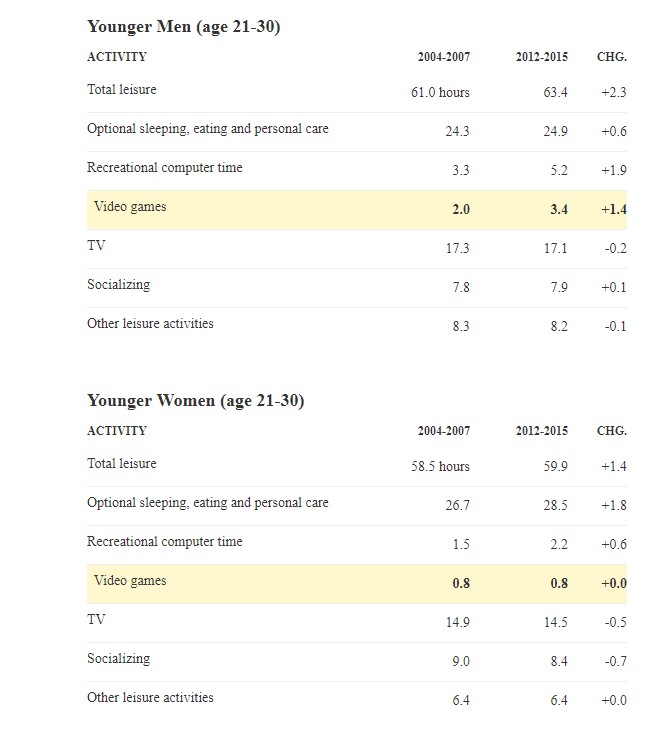
Young men vs. Young women on leisure (From The New York Times)
- Young men (ages 21-30)
- Optional sleeping, eating, and personal care: 24.9
- Watching TV: 17.1
- Socializing: 7.9
- Other leisure activities: 8.2
- Young women (ages 21-30)
- Optional sleeping, eating, and personal care: 28.5
- Watching TV: 14.2
- Socializing: 8.4
- Other leisure activities: 6.4
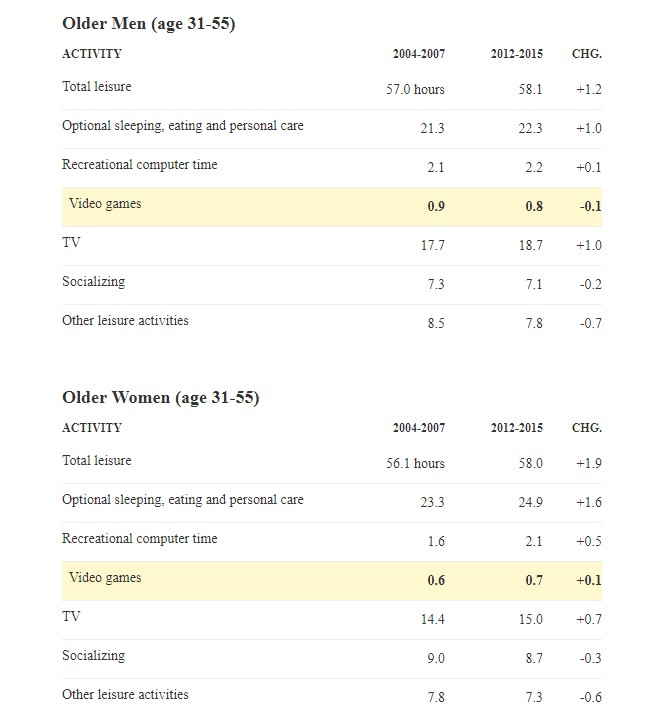
Older men vs. Older women on leisure (From the New York Times)
- Older men (ages 31-55)
- Optional sleeping, eating, and personal care: 22.3
- Watching TV: 18.7
- Socializing: 7.1
- Other leisure activities: 7.8
- Older women (ages 31-55)
- Optional sleeping, eating, and personal care: 24.9
- Watching TV: 15.0
- Socializing: 8.7
- Other leisure activities: 7.3
As you can see, everyone watches TV far more than playing video games. Are we then losing a generation of everyone to TV, especially Game of Thrones, or “Netflix and chill?” Can we even say that?
But of course, video games are an easy target because it is perceived as “not productive”. Smith even implies this himself saying “Every hour spent on ‘Ghost Recon’ or ‘Grand Theft Auto V’ is an hour that could have been spent more productively”. Like watching Game of Thrones marathons or whatever it is you watch for 18 hours a week?
Yet then again, Smith also thinks that teenagers having sex is a sign of “real relationships”. You don’t believe me? Read his final paragraph with the link that says “Gamer zombies risk losing touch with both the world of work and with the potential for real human relationships”. Call me 1950’s old-fashioned, but I prefer teens to not have sex until they reach adulthood; even with contraceptives, that’s still a lot of baggage for teens to carry.
So, yes, I will concede that young men are gaming more than ever, but no, we’re not losing them to video games. There are many other factors like lack of preparation from colleges which make it harder for grads to be fully employed, and the recent opioid epidemic that is causing people to miss work altogether.
So I ask again: are we losing our generation to TV?

- Uncategorized
 The Real-Time Technology Challenge Most Users Never Notice
June 30, 2026
- Uncategorized
 Mini Review: Shadow Tactics: Blades of the Shogun (Switch 2 Edition)
April 6, 2026
- Uncategorized
 Nintendo announces Treehouse: Live featuring Pokemon Pokopia and Super Mario Bros Wonder
February 23, 2026


- UncategorizedThe Real-Time Technology Challenge Most Users Never Notice
June 30, 2026
- UncategorizedMini Review: Shadow Tactics: Blades of the Shogun (Switch 2 Edition)
April 6, 2026
- UncategorizedNintendo announces Treehouse: Live featuring Pokemon Pokopia and Super Mario Bros Wonder
February 23, 2026
- Uncategorized
 Sonic Racing: CrossWorlds Nintendo Switch 2 Edition releases December 4
November 6, 2025