Summary
Monument Valley has never been about difficulty. These games are more about presence than challenge, more about feeling than frustration. Monument Valley 3 continues that philosophy while pushing its boundaries outward. It doesn’t reinvent the formula entirely, but it evolves it in quiet, confident ways.
As a standalone experience, it offers a deeply satisfying journey filled with moments of awe. As part of the series, it represents a thoughtful growth that respects its past while seeking new shores.
Even with a few missteps in its expanded scale, Monument Valley 3 stands as another elegant triumph of design, emotion, and artistry. It remains a series like no other, still strange, still beautiful, still full of wonder.
Developer – ustwo games
Publisher – ustwo games
Platforms – Nintendo Switch , PS4/5 , Xbox Series S|X, PC (Reviewed)
Review copy given by Developer

The Monument Valley series has always been about elegance in motion. Since its debut in 2014, it’s stood out not just as a puzzle game, but as a piece of interactive art. The original Monument Valley surprised players with its Escher-like architecture and wordless storytelling. Its sequel, Monument Valley 2, introduced a more emotional core, focusing on a mother and child navigating a crumbling, mysterious world. Both games were compact, visually striking, and deeply meditative experiences.
With Monument Valley 3, ustwo games didn’t just aim to revisit that magic. They’ve expanded the scale in nearly every direction. From its longer campaign to the introduction of a seafaring mechanic, this is a bolder, more ambitious entry. But even as the game swells in scope, it retains the same minimalist soul that made its predecessors so iconic. The result is a memorable and emotionally resonant journey, even if a few new elements occasionally stumble.
This time around, you play as Noor, a young apprentice traveling through a fading world of sacred light. Her mission is part pilgrimage, part restoration. As Noor sails between islands and explores shifting ruins, she slowly uncovers a world where ancient forces have begun to dim. The storytelling here follows the series tradition. It’s told mostly through visuals, ambient cues, and short, poetic interactions. There’s no exposition dump or traditional dialogue. Instead, meaning comes through motion, architecture, and space.
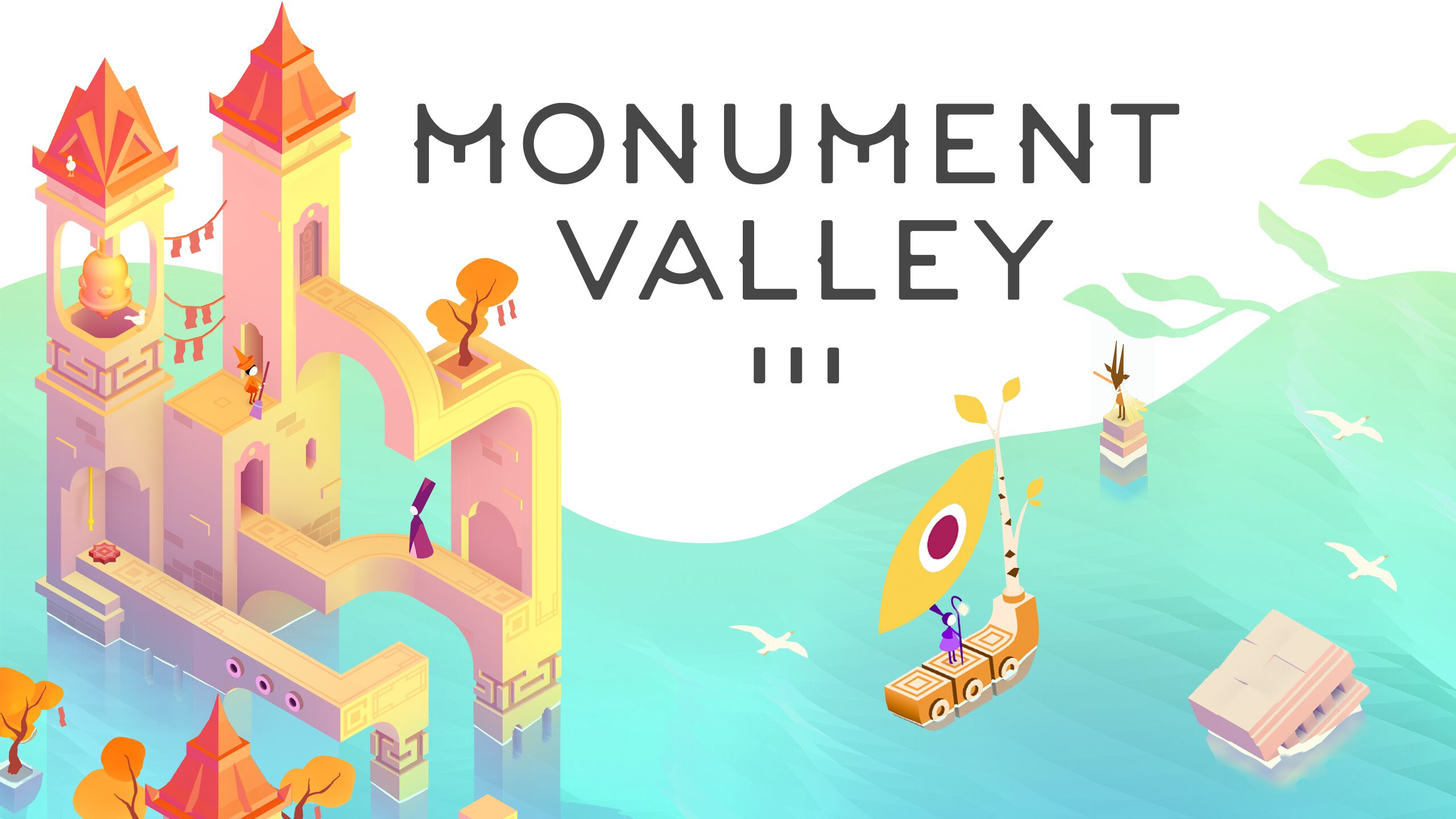
Right away, Monument Valley 3 feels more expansive than its predecessors. Where previous games were level-based with little connection between scenes, this installment takes on a lightly interconnected structure. Your boat serves as both hub and metaphor. It connects scattered islands and temples, but also represents Noor’s personal voyage. Rising tides, hidden currents, and crumbling docks add movement to what was once a purely linear game. The sense of flow is ever-present.
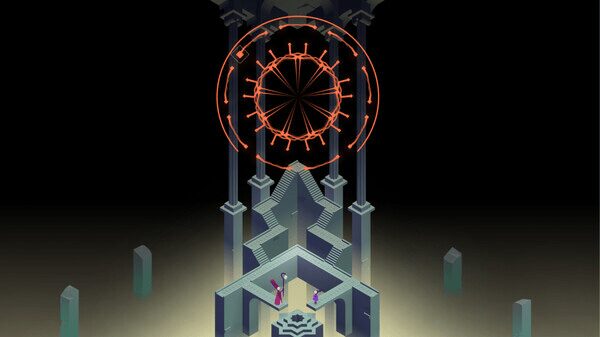
Mechanically, the game expands its puzzle vocabulary in meaningful ways. While perspective-shifting and impossible architecture remain at the core, new tools introduce fresh logic challenges. Gravity can now be twisted more freely. Some levels let you rotate entire chambers around Noor, while others introduce light as a guiding force. In one standout chapter, shadows themselves become walkable platforms, a brilliant play on perception. None of it feels gimmicky. These systems integrate smoothly into the game’s established logic.
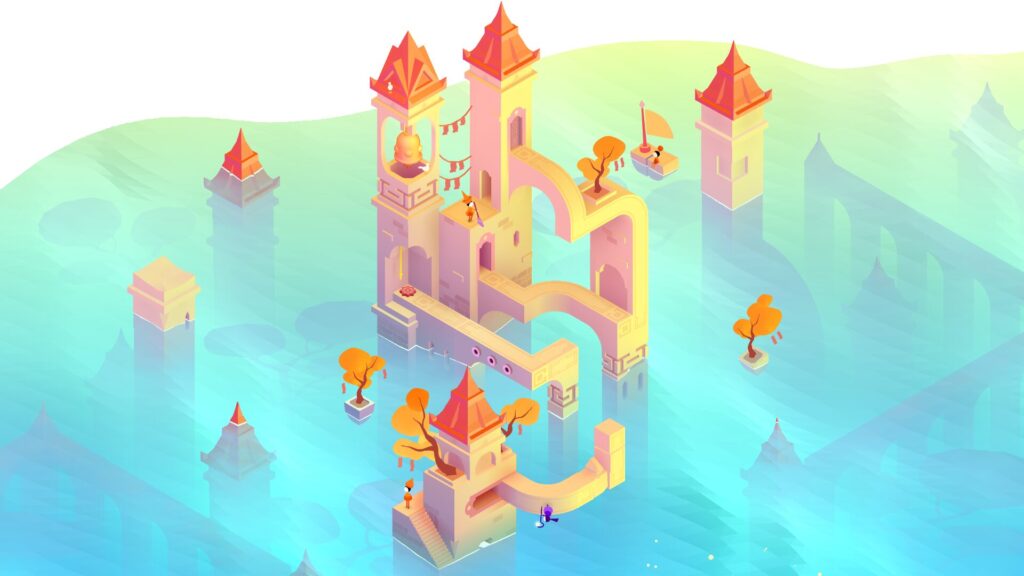
Perhaps the boldest addition is the way levels now sometimes change in real time. In earlier titles, players would rotate elements to create a path. Now, levels might reshape while you’re walking, or require you to sync your movements with a pulsing environmental rhythm. These moments are rare but striking. They add urgency and breath to a traditionally contemplative series.
Despite these innovations, the heart of the series remains untouched. The art direction is as painterly as ever, with soft gradients, mysterious ruins, and quietly divine temples. Each chapter introduces a distinct color palette and architectural motif. There’s a serenity to just existing in these spaces. The sound design remains impeccable too, with gentle harps, echoing winds, and subtle musical cues guiding your emotional response without overwhelming it.
Noor herself is more expressive than past protagonists. Her small gestures, pauses, and reactions give a sense of personality without saying a word. She’s not a blank slate, but a determined presence who learns and changes through experience. That emotional arc reaches some surprisingly touching peaks late in the game, though the game always stops short of being heavy-handed.
Where Monument Valley 3 stumbles slightly is in pacing. With its increased length and new mechanics, some chapters begin to feel less focused. A few puzzles lean more on trial-and-error than elegant deduction, especially those involving environmental timing or multi-stage rotations. These aren’t bad, but they lack the tight, one-screen brilliance that defined the earlier games. There’s also the occasional camera hiccup when perspective shifts become too elaborate. Rare, but noticeable.

The new boat mechanic, while beautiful, sometimes feels underused. There are moments when the sea acts as a meaningful part of the puzzle design, but often it’s just connective tissue between island-based stages. It could have offered more layered traversal challenges, or even environmental storytelling. As it stands, it’s more atmosphere than gameplay.
Still, the variety in locations more than makes up for any uneven moments. From forgotten cliffside temples to underwater vaults filled with shimmering crystal, the environments in Monument Valley 3 are among the best in the series. Each space feels lovingly crafted, encouraging exploration even within the game’s restrained design.
One thing worth noting is the delay of the game’s first DLC chapter, The Garden of Life. Originally slated to launch shortly after the base game, it’s now expected later this year. While this is disappointing, especially given the cliffhanger tone of the game’s epilogue, the developers have been clear that all future content will remain free. That promise helps take the sting out of the wait.

Monument Valley has never been about difficulty. These games are more about presence than challenge, more about feeling than frustration. Monument Valley 3 continues that philosophy while pushing its boundaries outward. It doesn’t reinvent the formula entirely, but it evolves it in quiet, confident ways.
As a standalone experience, it offers a deeply satisfying journey filled with moments of awe. As part of the series, it represents a thoughtful growth that respects its past while seeking new shores.
Even with a few missteps in its expanded scale, Monument Valley 3 stands as another elegant triumph of design, emotion, and artistry. It remains a series like no other, still strange, still beautiful, still full of wonder.