

Summary
In a year packed with clever roguelites, CloverPit still manages to stand out by being uncomfortably human. It’s a mirror held up to our own compulsions, our own need to pull one more lever, to see if maybe this time, luck is on our side. For Mac players, that’s especially true—they’ve had to live that metaphor just to get through the title screen.
Developer – Panik Arcade
Publisher – Future Friends Games
Platforms – PC (Reviewed)
Review copy given by Publisher
CloverPit is the kind of game that sinks its claws into you before you even realize you’ve stopped breathing. On paper, it sounds like a simple experiment in luck and risk, but once you’re trapped in its flickering, metallic cell with nothing but a slot machine for company, it’s easy to see how it became one of the most talked-about roguelites of the year. This is the demonic lovechild of Balatro and Buckshot Roulette, a twisted concoction of chance, punishment, and fleeting euphoria. It’s not about winning. It’s about surviving long enough to feel like you might.
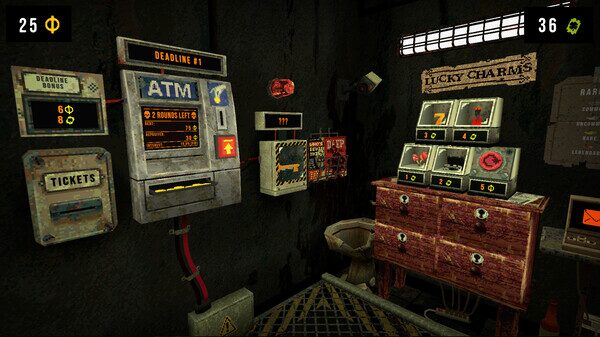
The setup is brutally straightforward. You’re locked in a grimy chamber with a cursed slot machine and a debt collector waiting outside the door. Each round, you spin, stack coins, and hope the payout is enough to keep you breathing. Fail, and your captor comes to collect. It’s a cruel loop of luck and dread that captures the essence of gambling without ever crossing into real money territory. The developer has made it clear that CloverPit isn’t about monetization—it’s about obsession. That distinction gives the game an eerie moral weight that other “casino roguelikes” never manage to achieve.

At its core, CloverPit’s slot system feels beautifully rigged in your favor until it suddenly isn’t. Every spin brings a new possibility for chaos. Prizes and charms modify outcomes in unpredictable ways, and stacking certain effects can trigger explosive chain reactions that feel both brilliant and terrifying. The game constantly tempts you to push your luck further, to squeeze out one more coin combo, to bend the rules of probability just enough to survive. It’s exhilarating when it works and crushing when it doesn’t, but that’s exactly the point.
Like Balatro, CloverPit thrives on synergy and meta-progression. You unlock new modifiers, items, and run variations that make future attempts even more deranged. There’s always a new way to cheat fate, a fresh combination of relics that make you feel like you’ve cracked the system. The pacing hits a perfect rhythm between despair and triumph, always dangling freedom just beyond reach.
Visually, it’s pure digital damnation. The flicker of the slot reels, the grime on the steel walls, and the pulsing red light of your cell create a claustrophobic rhythm that feels like you’re living inside a haunted arcade cabinet. The sound design seals the deal: warped chimes, muffled laughter, and the scraping of metal echo through the background, making every pull of the lever feel like a prayer you’re not sure will be answered.
That’s what makes the lack of Mac support sting so much. For a game this inventive, this culturally buzzy, it’s disappointing to see an entire segment of players locked out of the fun. The Mac gaming community, however, didn’t take that lying down. Within hours of release, forums were flooded with people dissecting compatibility layers, patching Wine wrappers, and testing performance on Apple Silicon just to make the game run. It became a community challenge in itself—Mac users trying to escape their own digital hell to play a game about escaping one. It’s ironic, poetic, and a little inspiring.
The developer’s decision not to ship a native Mac version is understandable on a technical level, but it feels like a missed opportunity given how fast Mac gaming has been accelerating. With the recent surge in optimization tools and the growing adoption of Metal 3 and Game Porting Toolkit, CloverPit could have easily been part of that wave. Instead, it sits just outside the door, taunting a player base that’s proven more determined than most to break in.

Still, once you do get it working, CloverPit feels worth the struggle. The tension between luck and control is balanced with near-perfect cruelty. It rewards experimentation, punishes overconfidence, and never stops making you second-guess your next pull. Runs are short but potent, dripping with the kind of anxiety that keeps you up at night thinking about what could’ve been if you’d just spun one more time.
Endless Mode in particular shows how elegantly the game can scale its madness. As the difficulty ramps, so does the satisfaction of surviving. The randomness never feels unfair, but it definitely feels personal, as if the machine itself knows your tendencies and wants to see you squirm. Combined with a chilling narrative thread about addiction and escape, the game constantly blurs the line between mastery and self-destruction.
Every item and synergy feels handcrafted to tempt you into excess. The best runs don’t come from discipline, they come from giving in—just for a moment—to the illusion of control. That makes CloverPit a rare kind of horror experience. It doesn’t scare you with monsters or gore, but with the reflection of your own impulses flickering on the slot machine screen.
Even with its rough edges and lack of native Mac support, CloverPit hits hard. It’s mechanically sharp, thematically focused, and dripping with personality. It understands the psychology of luck better than most games understand their own combat systems. And while its developer’s decision not to support every platform might disappoint, it’s clear the game’s allure was powerful enough to make players find a way anyway.
CloverPit isn’t perfect. It can be punishing to the point of exhaustion, and the RNG sometimes dips into pure chaos rather than clever design. But that unpredictability is part of its charm. Every run feels like a bargain with something you shouldn’t be bargaining with.
In a year packed with clever roguelites, CloverPit still manages to stand out by being uncomfortably human. It’s a mirror held up to our own compulsions, our own need to pull one more lever, to see if maybe this time, luck is on our side. For Mac players, that’s especially true—they’ve had to live that metaphor just to get through the title screen.